Survey Methodology
Matrix Questions: When Side-by-Side Comparisons Make Sense
Matrix survey questions stack Likert rows in a grid. When they help, when they hurt response rates, and the row limit and mobile rules that keep them usable.

Survey Methodology
Matrix survey questions stack Likert rows in a grid. When they help, when they hurt response rates, and the row limit and mobile rules that keep them usable.
Survey Methodology
Thumbs up/down survey questions strip feedback to a binary verdict. When to use them, where they break down, and how to pair them with a comment box.
Survey Methodology
Star rating survey questions are easy to understand but easy to misuse. When five stars beats a Likert scale, the labelling pitfalls, and how to read results.
Question Types
Likert scale survey questions measure attitudes on a five or seven point scale. How to pick scale length, label each point clearly, and avoid biased wording.
Survey Methodology
Customer loyalty surveys built on the 0 to 10 recommendation question. How to design and follow up so the score drives real change, beyond a dashboard tile.
Customer Experience
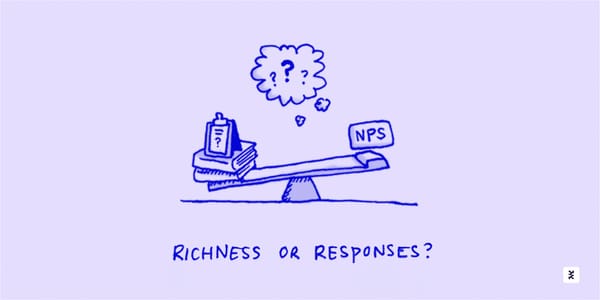
Long surveys give richer data but tank completion rates. How to get detailed customer feedback without the survey fatigue, with practical design trade-offs.

Employee Experience
If you run an employee survey that allows individual questions to be skipped (which it should!) then you might wonder if this has an impact on representation or margin of error. This is what to expect from employees skipping questions.

Employee Experience
In many organizations, “anonymous” surveys are actually better described as “confidential.” There’s a critical difference: truly anonymous surveys don’t track who provided which response, whereas confidential ones can tie responses back to individuals.

Employee Experience
If you’re looking to truly understand how your employees feel and why they feel that way, the answer is a resounding “yes.” Open-ended questions bring depth and nuance that purely numerical ratings often miss. Here’s a closer look at how you should be using free-text feedback in your surveys.

Employee Experience
Benchmarking can be helpful, but it shouldn’t overshadow your overall engagement strategy. Here are three points to keep in mind when deciding who you stack up against.

Employee Experience
Benchmarking an employee engagement survey by comparing your engagement survey results with external norms can certainly offer valuable context. But it’s not the silver bullet some might expect. Here’s what to keep in mind.

Employee Experience
When designing an employee engagement survey, a common concern is choosing the right questions. You don’t want to waste anyone’s time, and you need insights that will guide real action. Here are three key considerations.